

Answer engine optimization is the work of writing and structuring a site so an AI tool can quote it. One clear sentence per fact. Real prices, real names, real proof. Structured data that matches what a visitor sees. AEO is not a second website, it is a reading layer on the one you already have.
That is the whole idea in 55 words. Everything below is what it takes to be on the other side of it.
Why this is different from SEO
Search engine optimisation aims to rank a link. The visitor clicks, lands on your page and decides for themselves.
An answer engine reads the page first, decides what the page says, and then usually answers the question without a click. If your site cannot be quoted, it does not appear at all. Ranking tenth still gets you a click in search. Being unquotable gets you nothing in an answer.
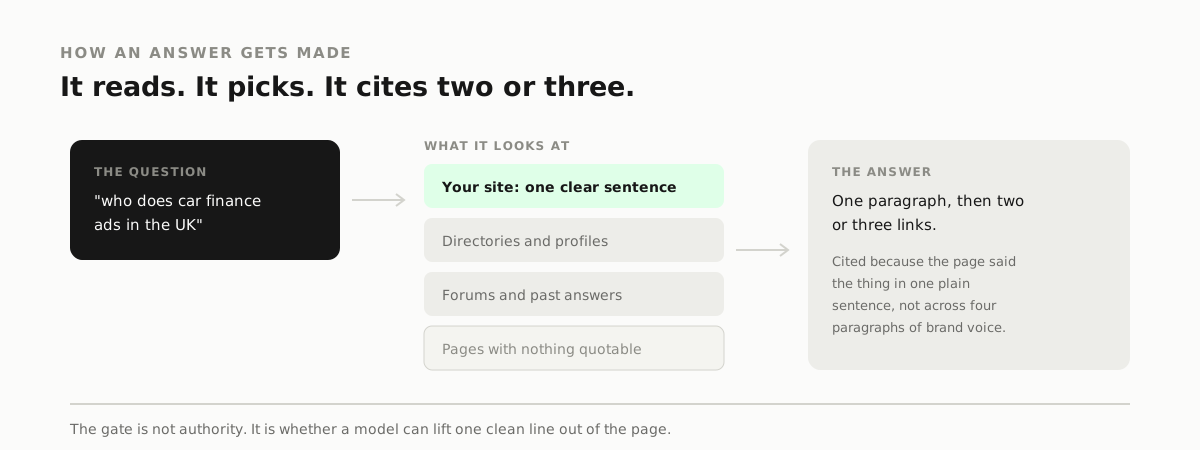
How an answer gets assembled
A question arrives. The tool checks several sources: your site, your profiles and directories, forums, and whatever it already answered before.
Then it picks two or three of them, and writes a paragraph in its own words with links.
The gate is not authority. It is whether a model can lift one clean line out of the page. A page that says what it does across four paragraphs of brand voice gives it nothing to lift. A page with one sentence and a real number gives it the whole answer.
The four things that decide whether you get cited
1. One fact, one sentence. "A standard tracking setup costs $450 and takes 10 working days" can be quoted. "We believe in delivering value through a bespoke approach to analytics" cannot.
2. Numbers that are actually on the page. Prices, delivery times, review counts, project counts. If a number only exists in your head, it cannot appear in an answer about you.
3. A named person. "Jayneid founded LeadMasterAgency and runs the Meta accounts" is checkable. A page signed by a company logo is not, and answer engines treat it accordingly.
4. Structured data that matches the visible page. FAQ markup that repeats questions a visitor can read, an Organization block with the same name and address as the footer, breadcrumbs that match the URL. Mismatch is worse than nothing.
What AEO is not
It is not a guaranteed mention in ChatGPT. Nobody can promise that, and anyone who does is selling you the one thing they cannot control. Answers are generated per question and change between runs.
It is not a pile of keyword-stuffed FAQ sections. A page of forty questions nobody asked reads like a template and gets cited like one.
It is not something you bolt on after the site is finished. If the copy is unquotable, the markup cannot rescue it.
A practical checklist
- Does the homepage say what the business is in the first two sentences?
- Does every service page state its price, or say it is quoted, in the first screen?
- Is there a named person, with a role, on an About page that resolves?
- Do the FAQ answers on the page match the FAQ markup exactly?
- Does `/llms.txt` exist and list the real pages?
- Are any AI crawlers blocked in robots.txt? Check before you assume.
How we track our own visibility
We run a fixed set of buyer questions against ChatGPT, Perplexity and Google AI on a set date, and record the answer, the sources cited and whether we were named. When we change a page we re-run the same prompts and log what moved, including the runs where nothing did.
No screenshots of lucky answers. No score picked after the fact. The method is the deliverable, and you can repeat it on your own brand in an afternoon.
One worked example
A dental clinic wants to be the answer to "invisalign cost [city]".
The unquotable version of their page says: "We pride ourselves on delivering exceptional care with a patient-first approach." That sentence cannot appear in an answer about anything.
The quotable version says: "Invisalign at the clinic starts at $2,400 for a full course, including retainers and two years of follow-up. A consultation is free and takes 20 minutes." Now the model has a number, a scope and a next step. That sentence gets cited, and it also converts when a human lands on it.
Same clinic, same treatment, one rewritten paragraph. That is the whole job.
Your first week, in order
- List the five questions buyers ask before they call.
- Find the page that should answer each one.
- Rewrite the first screen of that page with one plain sentence per fact.
- Add the number and the name.
- Run the free check and see which of the five you already appear in.
Two of the five is a normal first result. The work is moving two to four, then holding it.
Where to start
Pick the three questions your buyers actually type. Write one plain sentence on your site that answers each. Put a number and a name next to it. Then add the markup that repeats it.
That is most of the work, and it makes the regular SEO better at the same time, because a page that answers one question clearly ranks for that question too.
If you want the audit, the AEO service page lists what the free visibility check covers. If you are earlier in the process and the problem is that clicks are not becoming sales, start with why your Meta ads get clicks but no sales instead. AEO brings the right visitor. It cannot fix the page they land on.
Searches this answers
- what is answer engine optimization
- aeo vs seo
- how to appear in chatgpt answers
- ai search optimization
- llms.txt
- get cited by perplexity
THE SERVICE BEHIND THIS POST
AEO
Make your business clear, verifiable and easy to cite when buyers ask ChatGPT, Perplexity and Google AI who to hire.See how AEO worksNEED THIS APPLIED TO YOUR OWN ADS?
Get a free ad audit