Six to twelve, and here is why
A batch of six is the smallest number that can answer a question without luck. A batch of twelve is the largest number you can read before the data gets thin on each variation. Below six you are guessing. Above twelve you are paying for ads nobody will ever see enough of to judge.
The number matters less than what the variations are. Six resized crops of one idea is one variation printed six times.
Three questions per batch
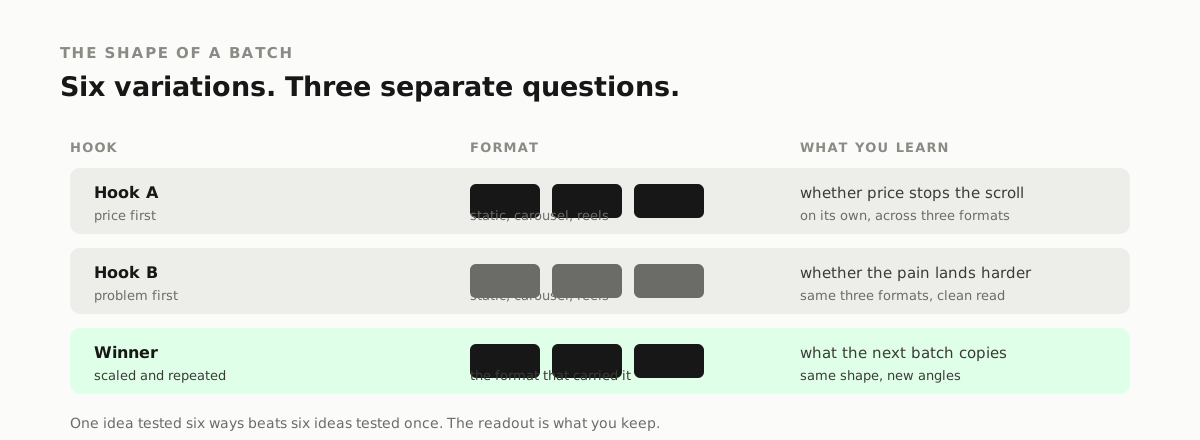
We build each batch around three questions, two variations each.
Question one: which promise lands? Same product, same format, different opening line. Price first, problem first, outcome first. Two of these, and you learn which entry point the audience actually responds to.
Question two: which format carries it? Take the winning line and build it as a static, a carousel and a short video. Same words, three shapes. This is the test most accounts skip, and it is usually where the cheap win is.
Question three: does it hold on a second angle? A different hook, built in the format that just won. If it holds, you have a system. If it collapses, the first win was the hook, not the offer, and that is worth knowing before you spend more.
What is not a variation
- A crop. A resize. A reposition.
- The same headline with a different colour button.
- A stock photo swap with identical copy.
- Anything you cannot name out loud in one sentence.
If you cannot say what the difference is meant to test, it is not a variation, it is a lottery ticket.
How long a batch should run
Long enough to read, short enough to matter. For most accounts that is five to seven days at a spend that produces at least a few hundred impressions per variation. Judging on day one tells you about delivery, not about the ad.
Stop a variation early only if it is clearly broken: rejected, no delivery, or a cost per result so far above the others that no amount of time closes it.
Reading fatigue correctly
Frequency above three on a small audience is normal and not automatically a problem. The signal is a falling click-through rate on the same audience with no change in the offer, and it usually appears at the same time as a rising cost per result.
When that happens, do not pause the winner. Build the next batch from the same angle, with a new opening line. The angle is the asset, the ad is the delivery.
How many batches a month
One batch a month is enough for most accounts, as long as it is finished before the previous one is exhausted. Two a month is right when you are launching a new product or running a seasonal push.
The failure mode is not too few batches. It is a batch every week, each one abandoned before it had time to read, and no record of what any of them taught.
Name the file so it explains itself
Every creative we deliver carries the same three parts: the angle, the format, the ratio. `price-first_reels_9x16_v2` tells a media buyer everything without opening it. `final-final-2.png` tells them nothing and costs a week.
That convention is also how you build a library instead of a folder. Six months in, you can search every ad you have ever run by angle, find the one that worked in March, and rebuild it for a new offer in an hour.
Why batching beats one-off requests
One ad at a time means every test is also a production project: another brief, another round of feedback, another week. Six at once means the feedback loop runs weekly instead of monthly, and the account learns four times faster for the same money.
That is the whole argument for the Ad Creative service, and it is why the batch is priced per creative rather than per project. From $10 per creative on the pricing page, so a batch is a predictable line item instead of a negotiation.
The files matter as much as the idea
A batch that arrives as twelve files named `final-final-2.png`, in one size, will lose a week in upload. Every creative we deliver is named by angle and format and exported at 1:1, 4:5 and 9:16, so the media buyer can launch in minutes.
If you want the size and safe-zone details, ad image sizes and the 400 pixel test covers the technical half.
Searches this answers
- how many ad variations
- facebook ads creative testing
- ad variations per ad set
- meta ads creative fatigue
- creative testing budget
- meta ads creative batch
THE SERVICE BEHIND THIS POST
Ad Creative
Launch-ready ad creative built in batches of 6 to 12 variations, with hooks and copy included.See how Ad Creative worksNEED THIS APPLIED TO YOUR OWN ADS?
Get a free ad audit