

Three to five posts a week
That is the honest answer for a small business, and it is not a compromise. Three posts a week that each do a job will beat fourteen that exist to fill a grid.
The number people quote, one a day plus stories plus reels, comes from teams with a full-time editor. If you are posting daily and none of it is landing, the cadence is not the thing to fix. The mix is.
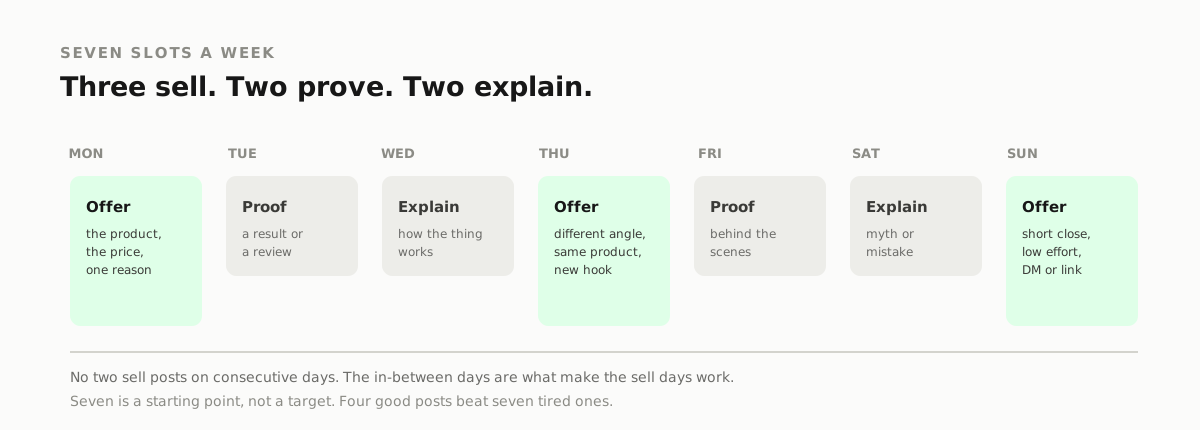
Give every post a job
There are only three jobs a post can do.
Sell. Show the product, the price and one reason to buy now. This is the post everybody wants to make and nobody wants to see too often.
Prove. A result, a review, a before and after, a customer using the thing. Proof does the work your claims cannot.
Explain. How it works, what it costs, why you do it that way, what a common mistake is. This is the post that gets saved and shared, and it is the one most small accounts skip.
Three posts a week is one of each. Five is two sells, two proofs and an explanation. Seven, as in the grid above, is the maximum before you are making content nobody asked for.
Spacing beats volume
Two sell posts on consecutive days feel like a shop that keeps shouting. The same two posts separated by an explain post feel like a business talking normally.
The in-between days are what make the sell days work. They are not filler, they are the reason the audience has not muted you.
Batch production, not daily creation
Pick one afternoon a week. Photograph everything in one session, write the copy for the week, schedule it. Daily creation is how a content plan dies in week three.
A batch of three posts should take two hours once the photos exist. If it is taking six, the problem is the brief, not the feed.
The same shoot usually produces the raw material for paid ads, and the same rules apply: several versions of the same idea, each testing one thing. How many ad variations you need covers that side of the shoot.
Stories are not a content calendar
Stories are for the people who already follow you: reminders, a poll, a look at today's work, a link to the post that just went live. They are cheap to make and they do not replace a feed post.
If your whole plan is stories, you are talking to the same small group every day and never reaching anyone new. Feed posts do the reaching, stories do the keeping in touch.
When a post flops
Most will. A post that underperforms is not a reason to change the plan, it is a single data point.
Look at two things before you react. Did it reach anyone at all? If reach was normal and engagement was low, the hook did not work, and the fix is the first line. If reach was low, the audience did not respond to the format, and the fix is the shape, not the words.
Rewrite the first line and repost the same idea in a month. Roughly half the time it works the second time, which tells you the idea was fine and the opening was not.
What to cut first
When a week gets busy, cut in this order:
- The second explain post.
- Stories, if you are using them as a checklist rather than a tool.
- The second proof post.
- Nothing else.
Never cut the sell post entirely and never cut proof entirely. A feed with no ask and no evidence is a portfolio, not a business.
Does frequency actually change reach in 2026
Less than it used to. Instagram shows a post to the audience that has responded to similar posts before, and the size of that audience depends on how the last twenty posts performed, not how many you published this week.
Two good posts a week, compounding for three months, will out-reach five tired ones published for a month and abandoned. Consistency is the variable, not frequency.
The schedule most clients end up with
Monday sell, Tuesday proof, Wednesday explain, Thursday sell with a different angle, Friday behind the scenes, weekend off unless something real happens.
That is five. Once it is running, the sixth slot is usually another proof, because proof is the post people screenshot and send to a friend.
What this looks like as a service
If you would rather not build the grid yourself, Social Media Management includes the plan, the copy, the design and the publishing, with everything approved before it goes live.
Either way, start with three a week and a job for each. You can always add a fourth when the first three are working, and you will know they are working because the saves and replies go up, not because the grid looks fuller.
Searches this answers
- how often to post on instagram
- instagram posting schedule small business
- social media posting frequency
- instagram content plan
- how many times a week to post
THE SERVICE BEHIND THIS POST
Social Media Management
12 to 20 custom posts, carousels and Story sequences every month across Instagram, Facebook and LinkedIn. You approve every post before it goes live.See how Social Media Management worksNEED THIS APPLIED TO YOUR OWN ADS?
Get a free ad audit