

The number nobody gives you
Ask three agencies what minimum budget you need and you get three numbers, each chosen to sound safe. The real answer is arithmetic. You need enough spend to buy a read, not enough to buy a feeling.
A read means one thing: this ad set has produced enough of the same event that what you are looking at is not noise. Most owners quit before the read and call it a failed test.
The threshold that actually matters
Meta's own learning-phase guidance is around 50 optimisation events per ad set per week. Below that, delivery keeps hunting for the result. Above it, the system has a pattern to work with. Treat 50 as the target, not a law. Twenty can still work, it just takes longer and the answer is thinner.
So work backwards from your own numbers.
If your average order value is $60 and you would accept $40 per purchase, then 50 purchases is $2,000 in spend for one ad set. That is the arithmetic, not a promise. A second ad set doubles it. Two ad sets at $2,000 a week is why most small accounts should not start on a purchase event at all.
The mistake is not the budget. The mistake is picking an event that is too rare for the budget to read. If your monthly sales cannot support 50 purchase events a week, optimise on something that happens more often and still means money: add to cart, a lead form, a booked call, a message.
Phase one: learn
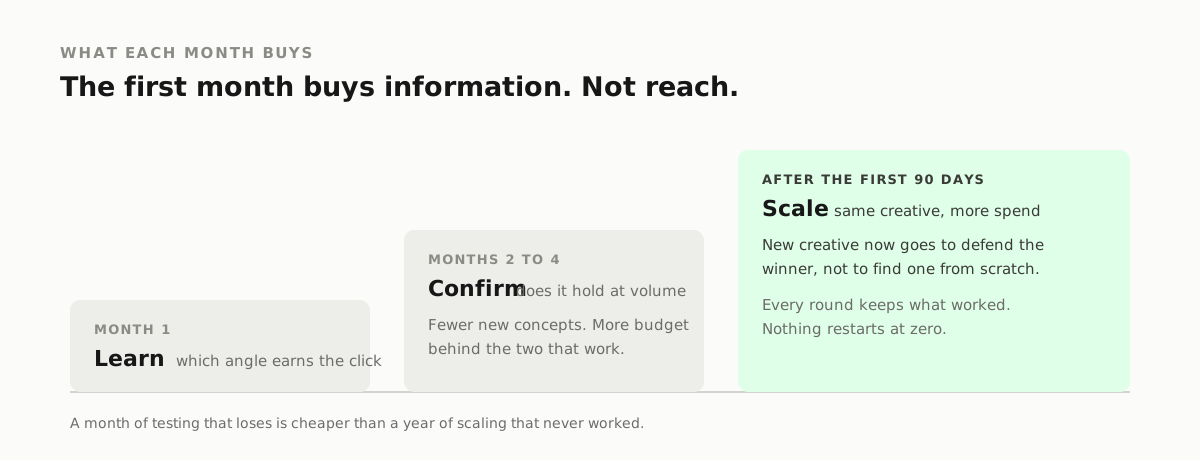
Roughly the first month. Spend small, test angles, and do not judge return on ad spend yet. What you are buying is the answer to two questions: which hook earns the click, and which offer earns the sale.
Read results at the ad level, not the account level. An account number hides the fact that one ad is carrying the other nine.
Phase two: confirm
Month two to four. Fewer new concepts, more budget behind the two that worked. You are not looking for another winner now, you are checking whether the first one survives more money.
Most ads that work at $20 a day fall apart at $200 a day. That is not bad luck, it is reach moving outside the group that responded. Finding out costs less now than after you have rebuilt the business around it.
Phase three: scale
Only here does more money mean more of the same result. New creative goes to defend the winner, not to find one from scratch. If you skip phases one and two, this phase is where the budget disappears fastest, because there is nothing proven to scale.
When the budget is below the threshold
Five options, in the order we use them:
- Optimise on a higher-volume event.
- Consolidate ad sets so one has enough budget to leave the learning phase.
- Run fewer ads for longer instead of eight ads for a week.
- Accept a longer read, three to four weeks rather than seven days.
- Do not test everything at once. One question per batch.
Any of these beats adding budget to an answer you cannot read yet.
Three signs you started spending too early
- You are raising budget on a campaign whose best ad is four days old.
- You cannot name the winning hook. If you cannot say which angle won, you bought impressions, not information.
- Your cost per result swings three times a day to day. That is not performance, that is not enough data.
The boost button is not a budget plan
Boosting a post that already performed is the cheapest test there is, and it is not a plan. It buys distribution on one asset with no structure behind it: no ad set to read, no event to optimise on, no way to tell whether the result came from the post or the placement.
Use it once, to check whether an organic winner survives paid reach. If it does, rebuild it properly as an ad, inside a campaign where you can measure the next step.
When to stop and reset
If three months of spend have produced no ad you would scale, the answer is not more budget. Something earlier is wrong, usually the offer or the page the ad points at.
Stop spending, spend one week on the four checks in why your Meta ads get clicks but no sales, fix the first break you find, then restart at the lowest budget that can produce a read. Restarting after a fix is a decision. Restarting after a hunch is just a reset button.
What the management fee is, and is not
Our Meta Ads work is a flat monthly fee, never a percentage of what you spend. On a percentage deal, a small budget is punished twice: you pay for the management and the agency earns more when you spend more, working or not. Flat means the fee stays the same whether you are testing at a low spend or scaling.
The prices are on the pricing page. Ad spend goes to Meta directly, from your card.
The short version
Start with the event your budget can read. Spend the first month buying information. Spend the next three confirming it. Only then scale. If you want a second pair of eyes on whether your current spend is producing a read or just impressions, the Meta Ads service page lists what the audit covers, and why clicks do not become sales is the next thing to rule out.
Searches this answers
- how much to spend on meta ads
- facebook ads budget for small business
- minimum ad spend meta ads
- meta ads budget schedule
- when to scale meta ads
- meta ads learning phase 50 conversions
THE SERVICE BEHIND THIS POST
Meta Ads
We run your Facebook and Instagram ads end to end: clean structure, disciplined creative testing, retargeting and a weekly report in plain English.See how Meta Ads worksNEED THIS APPLIED TO YOUR OWN ADS?
Get a free ad audit