

What Advantage+ actually does
Advantage+ hands Meta three decisions you used to make by hand: who sees the ad, where it appears, and how the budget splits.
That is it. It is not a new targeting system with secret data. It is the same auction, with the platform choosing the audience and the placement instead of you.
Which means the machine is only as good as the signal you feed it. Good data in, better decisions out. Thin data in, expensive guessing out.
When it works
Advantage+ performs when three things are true.
There is conversion volume. Meta needs roughly 50 optimisation events a week per ad set to leave the learning phase. A shop doing 200 purchases a month can feed it. A shop doing 12 cannot.
The signal is clean. Pixel and Conversions API sending the same events with the same event IDs, no duplicate purchases, no broken checkout event. If the purchase fires twice, the system learns to chase the wrong people twice as hard.
There are five or more creatives worth running. Advantage+ recombines creative. Give it one image and it has nothing to recombine. Give it six angles and it finds pairings you would never have tried by hand.
When it wastes budget
- A brand new ad account with no purchase history. There is no signal to optimise against yet.
- A narrow B2B list where the buyer is 40 named accounts.
- A single creative, or six creatives that all say the same thing.
- An offer that needs a paragraph to explain. Feed ads cannot explain.
- Seasonal spikes where you need exact daily spend, not an average across a week.
None of this makes Advantage+ bad. It makes it the wrong tool for those jobs.
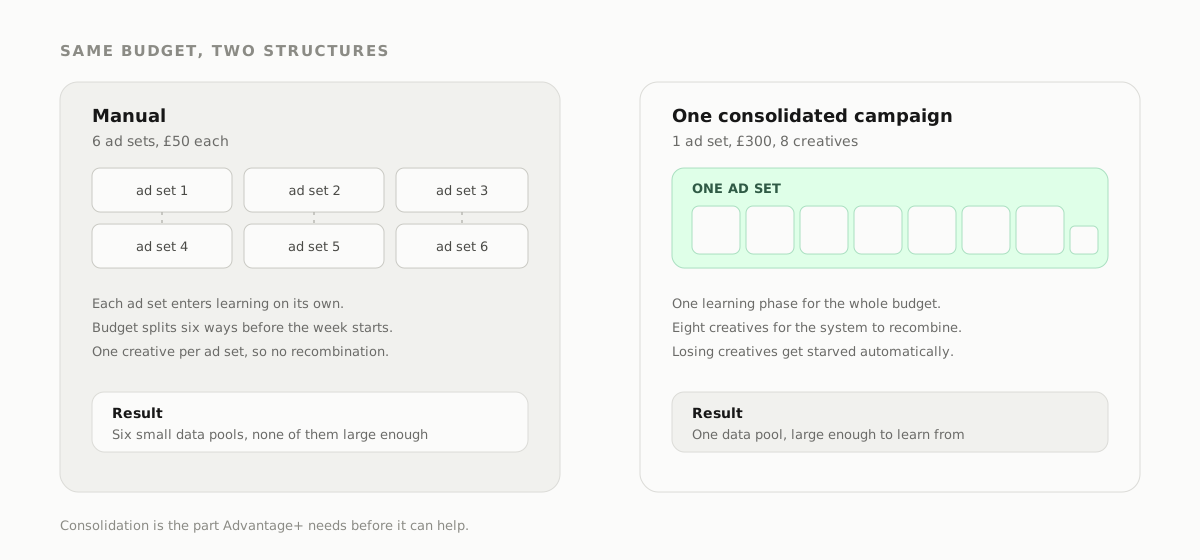
The setup we use
- One campaign per country or language. Not one per audience.
- One ad set, with the budget at campaign level.
- Broad targeting, plus exclusions for past purchasers if repeat rate is low.
- Six to twelve creatives, at least three different angles.
- Conversions API live and deduplicated before launch.
- A seven-day no-touch window. Editing the budget every day resets learning and wastes the week.
The three numbers that matter
Cost per new customer. Not blended ROAS. If most orders come from returning buyers, a strong ROAS can still hide a losing campaign.
Frequency. Above 3 in seven days on a small audience means the creative is tired, not the audience.
Share of spend on the top creative. Advantage+ concentrates budget. That is fine while the creative holds. When one ad takes 80% of spend and cost per purchase climbs, the batch is finished.
When to switch it off
Turn it off, or split it back into manual, when:
- Cost per new customer is above target for two weeks with the same creative.
- Frequency climbs while reach falls.
- The account cannot generate 50 events a week and the learning phase never ends.
- You need a hard cap on spend for one product or one region.
Switching off is not a loss. It is a decision made on numbers you actually have.
The mistake that costs the most
Judging a campaign after 48 hours. Advantage+ needs a week to leave learning. Every budget edit sends it back. If you cannot leave it alone for seven days, run a manual campaign you can steer, or set a budget you are willing to spend without touching it.
Budget floor
Advantage+ needs enough daily spend to collect events. The number is not fixed, but the logic is: if 50 events a week at your cost per purchase is more than you are willing to spend, the campaign will never leave learning and you should not be running it yet.
Work backwards. If a purchase costs about 20 and you need 50 purchases a week, the campaign needs roughly 1,000 a week to learn properly. If that is out of reach, lower the optimisation event (add to cart or lead) or stay manual until volume grows.
Creative supply is the real constraint
The account does not run out of budget. It runs out of creative.
Advantage+ will keep spending on whatever holds attention, and attention decays. A batch of six to twelve new creatives every two to four weeks is normal for a scaling account. When the same images run for two months, frequency climbs, cost per purchase climbs, and the platform gets blamed for a supply problem.
If you only fix one thing this quarter, fix creative supply.
How to read the results table
Ignore the top-line ROAS for a second. Open the breakdown and look at four columns in this order.
- Amount spent per creative. Concentration tells you what the system trusts.
- Cost per purchase by creative. Find the one carrying the account.
- Frequency by ad set. Rising frequency with falling reach means fatigue.
- New vs existing customers. If most purchases are repeat buyers, you are paying to reach people who would have bought anyway.
That is the honest read. Everything else is a summary of these four.
A week-one checklist
- Campaign untouched for seven days.
- At least 50 optimisation events recorded.
- Frequency under 3.
- At least two creatives with meaningful spend.
- Cost per new customer inside target, or close enough to justify week two.
If four of the five are true, let it run. If two or more are false, change creative before you change anything else.
Searches this answers
- advantage+ campaign setup
- meta advantage+ campaigns explained
- advantage+ shopping campaign vs manual
- advantage+ campaign not working
- advantage+ campaign budget
- meta advantage+ audience
NEED THIS APPLIED TO YOUR OWN ADS?
Get a free ad audit